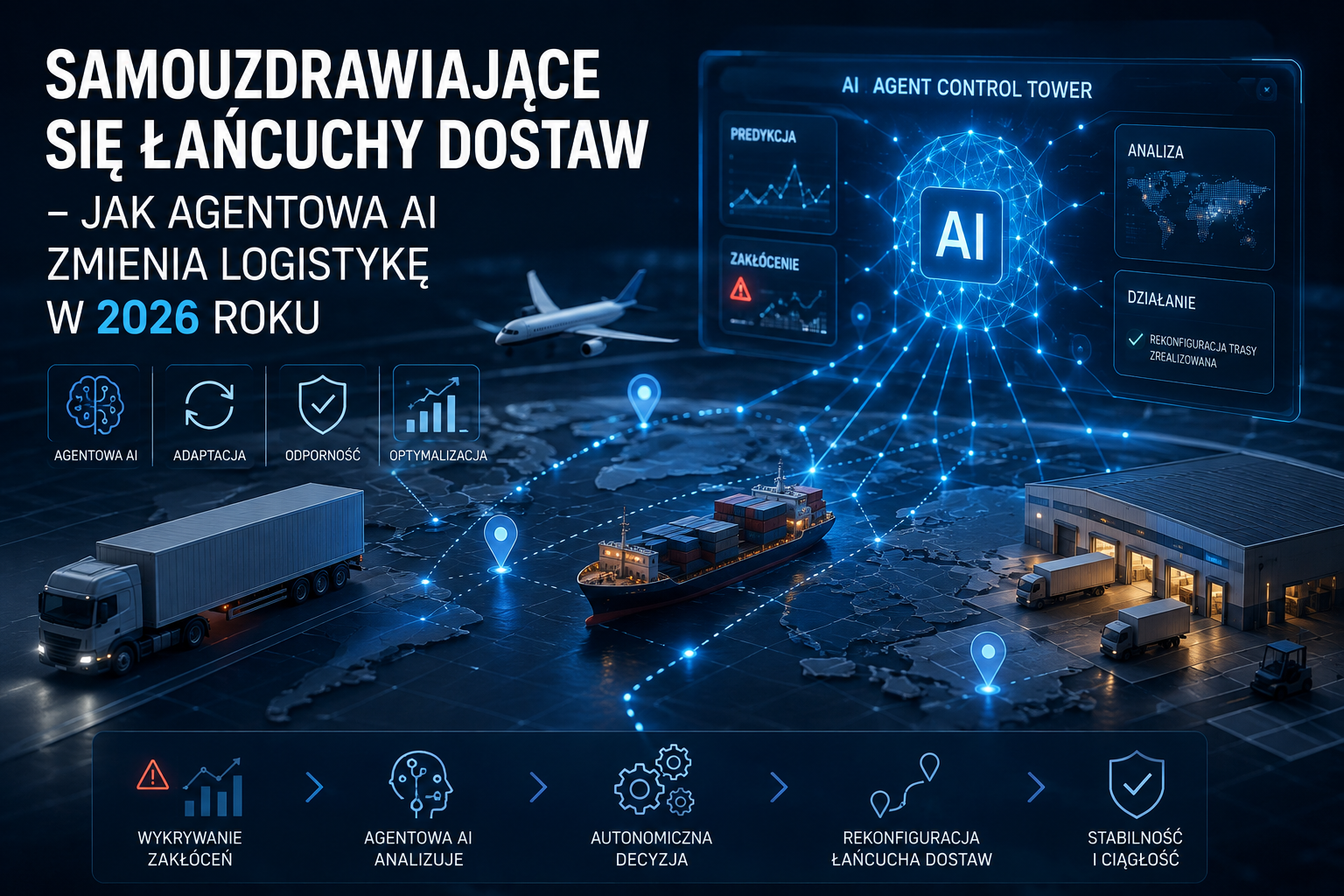
The year 2026 marks a turning point for the TSL industry. Artificial intelligence is no longer just an analytical tool—it is becoming an autonomous „operator” of the supply chain. Logistics is entering the era of so-called self-healing supply chains—systems that not only predict disruptions but autonomously eliminate them.
1. From Predictive to Agentic AI
Until now, AI in logistics mainly served to analyze historical data and forecasting. In 2026, we are dealing with agentic AI—systems capable of planning and executing multi-step tasks without human involvement.
What does this mean in practice? An AI agent can monitor fleet condition, detect an approaching vehicle failure, automatically schedule service, recalculate the route to another vehicle, and inform the customer about the new ETA—all within seconds.
2. Self-Healing Supply Chains
The biggest novelty of 2026 is self-healing supply chains. These systems use AI agents to autonomously:
- Reroute shipments in real time during port or border crossing closures
- Renegotiate freight rates in response to market changes
- Adjust inventory levels without planner intervention
- Activate contingency plans before a disruption affects the customer
This is a paradigm shift—from reactive logistics to fully autonomous operations where technology acts as a proactive partner.
3. Digital Twins – Testing the Future
Alongside agentic AI, digital twin technology is developing. It allows logistics companies to simulate „what-if” scenarios—port strikes, extreme weather events, fuel price spikes—without risking real operations.
The digital twin market is growing by 39% annually, and in 2026 this technology is becoming a central management tool in large logistics networks.
4. End-to-End Visibility as Standard
In 2026, supply chain visibility ceases to be a luxury and becomes a necessity. Companies are integrating ERP, WMS, TMS, and IoT systems into one ecosystem, gaining a full real-time operational picture.
For the transport industry, this means:
- Automatic alerts when deviations from the plan occur
- Tracking transport conditions (temperature, humidity) for sensitive cargo
- Full transparency for customers and regulators
5. Sustainable Transport – From Declarations to Action
2026 is also the year when sustainability stops being a marketing slogan and becomes an embedded operational feature. The EU’s CBAM mechanism is moving from a testing phase to real financial obligations, and companies must report CO₂ emissions associated with transport.
Fleet electrification, route optimization reducing empty miles, and shipment consolidation (LTL) are not just regulatory requirements but real operational savings.
2026 is a tipping point: logistics is shifting from crisis response to building intelligent resilience. Companies that implement agentic AI, digital twins, and full data integration will gain an invaluable competitive advantage.